

| Field | Details |
|---|---|
| Movie Name | Collateral (2004) |
| Director | Michael Mann |
| Writer | Stuart Beattie |
| Lead Cast | Tom Cruise, Jamie Foxx |
| Supporting Cast | Jada Pinkett Smith, Mark Ruffalo, Peter Berg, Bruce McGill, Irma P. Hall, Javier Bardem |
| Genre | Crime, Thriller, Drama |
| Release Date | August 6, 2004 (USA) |
| Duration | 120 minutes |
| Language | English |
| Budget | Approx. $65 million |
| Box Office | Approx. $220 million worldwide |
| IMDb Rating | 7.5/10 |
WATCH NOW




Collateral, which takes place over a single night from roughly dusk to just before dawn, is full of arresting images aerial views of the city’s grid, headlights sweeping across decaying neighborhoods, the parade of lights that are cars on the freeway, the grainy video of police surveillance cameras, a family of coyotes passing though an urban canyon of high rises. It is a view of L.A. as a criminal’s violent playground, a place awash in danger and yet still somehow seductive.
But style cannot stand alone, it exists to support the story and the characters and it is on those levels that Collateral falls miserably short. The set up is promising Vincent (Tom Cruise), a hitman, has flown into town just for the night to take out witnesses in an upcoming drug trafficking case. Driving him from place to place is Max (Jamie Foxx), a cabbie who is under the impression that he’s driving a visiting businessman to meetings and to see friends. Max is quickly disabused of that notion when Vincent’s first victim falls from his apartment window to land on Max’s taxi. Vincent responds my making Max his hostage, ordering him to continue driving him to his deadly appointments, but reassuring him that if Max just does what he’s told he will live through the night. Of course, Vincent continually makes the point that no one not even the men who hire him gets to see his face, so in reality, unless Max can make an escape, he will be dead by morning.
If Collateral focused on that dynamic, the relationship between this stone cold killer and the timid cabdriver, it might have made for a fascinating ride. Max is scared out of his wits, but not so terrified that he isn’t on the constant lookout for a way out. He’s also a bit of a dreamer, a man who’s been driving a cab for 12 years but maintains it’s only temporary, leaving open the question whether he has the judgment to fashion a means of escape. Vincent takes great pains to emphasize his professionalism and describes his work as “Darwinism,” insisting to Max that he’s only killing criminals, essentially taking out society’s trash and that may, indeed, be the lie he tells himself. He does have a code of ethics, as well. As the night progresses and his job goes more and more south, he could cut and run, but refuses to do so, reasoning that he’s been paid for a job so he has to finish it. And in a way, Vincent becomes as reliant on Max as Max is on him to remain alive.
Unfortunately, Mann and screenwriter Stuart Beattie aren’t content to settle for a psychological thriller, they want their action, too, and that’s where the movie begins to go completely awry. It’s bad enough that the entire story rests on a series of coincidences, beginning with the fact that Vincent gets into Max’s taxi just after U.S. attorney Annie Farrell (Jada Pinkett Smith), the very lawyer who is trying the drug case Vincent’s been hired to stop, gets out. The coincidences pile on from there: Max just happens to park exactly beneath the first victim’s apartment.
Since the body smashed the cab’s windshield, he and Vincent are quickly pulled over by cops who just happen to get a radio call calling them away from the stop, ensuring that Vincent’s killing spree can continue uninterrupted. And so on and so on, until the movie comes to the most absurd coincidence of all involving a cell phone that can only get a signal from the top of a parking structure that just happens to have the perfect view of the action unfolding across the way in a high rise. And maybe none of this would matter except that even within explosively violent scenes the pacing often slows to a crawl and Vincent’s hits are so crude and so unlikely that they begin to underline both the coincidences and other inconsistencies in the plot.
More egregious still is how, after building up Vincent as a fascinating character, Beattie betrays him by having him behave in ways that undermine his credibility. Of course, the movie would only be about half an hour long if Vincent acted completely consistently, since one of his first acts would have been to kill Max to eliminate a witness he certainly wouldn’t risk getting pulled over in a cab with a smashed windshield. But the inconsistency starts even earlier than that. Would a truly professional killer really shoot someone standing that close to window? Then there’s Vincent’s insistence that no one ever sees him. But all kinds of people see him and he doesn’t actually eliminate all witnesses, nor does he make an effort to disguise himself on a night where his business will take him, among other places, to a packed nightclub and a federal building that one presumes is filled with security cameras. He’s supposed to be a veteran hitman, but his behavior contradicts that.
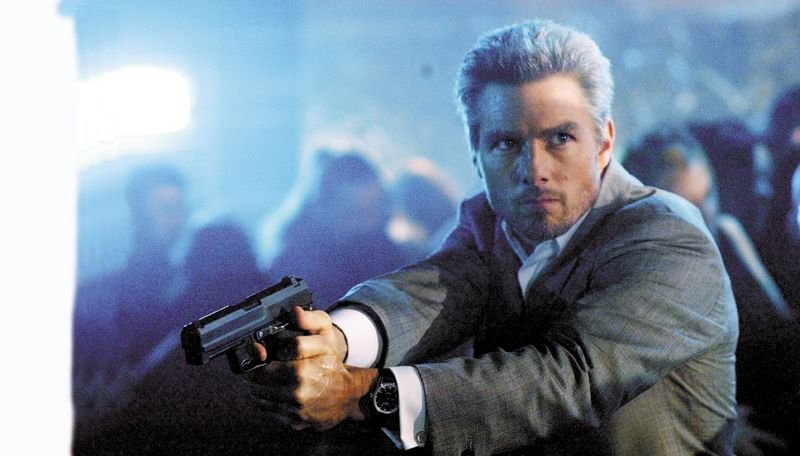
Poor Cruise, he even dyed his hair gray, no doubt remembering that Oscar nomination that accompanied Russell Crowe’s dye job when he worked with Mann on The Insider. Lightning is probably not going to strike twice, particularly since Foxx outclasses him. Admittedly, Foxx has an easier time of it Max is both more consistent and more sympathetic. Cruise, on the other hand, is stuck playing a character who is both ruthless and unbelievable. Ever the light leading man, the actor muddles through gamely, but as the movie wears on, his performance becomes more and more transparent.
Collateral truly feels like a missed opportunity for everyone involved. Stephen Frears told a similar story in The Hit, when a pair of hitmen played by John Hurt and Tim Roth develop a relationship with their stool-pigeon victim Terence Stamp on a ride across Spain. Frears and screenwriter Peter Prince hardly eschewed violence, but the emphasis of the story was on character. The result was a film rich in irony, often blackly comic, suspenseful, and mesmerizing. Perhaps Mann and Beattie should have taken a gander at that before starting this misadventure. The Hit, too, is extremely stylish, but it’s also so much more.
To watch more movies like Collateral (2004) visit Fmovies.
Also watch