
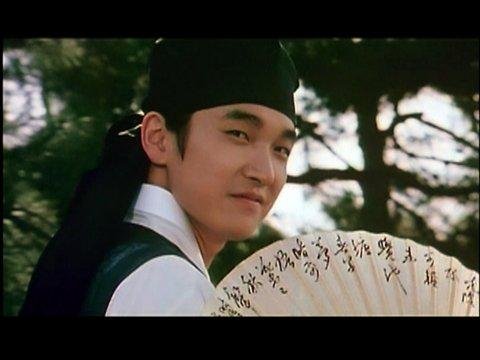

| Field | Details |
|---|---|
| Movie Name | Chunhyang |
| Release Year | 2000 (South Korea), 2001 (International release) |
| Director | Im Kwon-taek |
| Writer | Yoon Seok-yeong (pansori narrator), Based on the classic Korean folktale The Tale of Chunhyang |
| Lead Cast | Cho Seung-woo (as Mongryong), Lee Hyo-jeong (as Chunhyang) |
| Supporting Cast | Kim Sung-nyu, Lee Jung-hun, Im Dong-jin |
| Genre | Romance, Historical Drama, Musical |
| Language | Korean |
| Runtime | 120 minutes |
| Country | South Korea |
| IMDb Rating | 7.1/10 |
WATCH NOW

Chunhyang tells a familiar story boy meets girl, boy falls in love with girl, boy marries girl in secret, boy runs off to the royal capital for two years to cram for his Confucian civil service exam, girl is imprisoned and beaten by an evil lord for refusing to be his concubine, boy infiltrates evil lord’s court disguised as beggar on a mission from the king to expose corruption.
Ok, the minutiae of Im Kwok Taek’s film may not be that familiar, but you’ll quickly recognize the universal story elements of the fairy tale upon which it is based. You’ll also notice that it’s accompanied by sing song narration by a traditional Korean storyteller called a pansori. And although the narrator’s baritone takes some getting used to, it grows on you, putting a new twist on an age old tale, and making this film watch worthy.
The titular Chunhyang (Lee Hyo Jung) is a sweet, virginal child of a whore. A noble courtesan, to be more accurate, but that still doesn’t matter, since tradition dictates that she enter a life of sexual servitude to the local lord. But Chunhyang’s mother tries to shield her from that fate, keeping her hidden away in a country cottage outside town.
This remote locale still can’t hide the classic beauty from the lusty eyes of Mongryong (Cho Seung Woo), the spoiled son of the local governor. Smitten at first sight, he immediately marries Chunhyang in secret, overcoming her shyness with his sincere advances, and promptly schooling her in the ways of love, both in and outside the bedchamber.
Alas, the pair’s freewheeling frolicking can’t last long. Mongryong’s father is transferred to Seoul, and the dutiful son must follow so he can concentrate on the literature exam required by Confucian society to join the all-powerful civil service. Unfortunately, Confucian society wasn’t too keen on noble scions shacking up with lowly courtesans, so Mongryong must keep his marriage secret until after he takes the exam.
Chunhyang reluctantly agrees to let him go, but not in her wildest dreams did she anticipate he’d be gone for two years (hey, it’s an important exam). Nor could she imagine that her province’s new lord would be so cruel that he’d have her beaten within an inch of her life for not sharing his bed. So heartless is this petty aristocrat, that seeing Chunhyang bludgeoned to death with wooden clubs is serving as the main entertainment at the local governor’s convention he is hosting.
It’s pretty much a forgone conclusion that Mongryong will rescue Chunhyang before she perishes at the business end of a medieval Korean Louisville Slugger. But the fact that Mongryong takes his sweet time getting there makes much of the film a frustrating experience, and makes his character fairly unsympathetic. If he is so madly in love with Chunhyang, how could he forget to send word to her for years on end? Why does he let her suffer? More significantly, why does she stay true to a snooty playboy who she was only married to for a few months? Was he that good in the sack?
Had Chunhyang the film simply stuck to this standard story, it would’ve been pretty mediocre. But several things place it above the recent crop of so-so Asian period dramas like Temptress Moon and The Emperor and the Assassin. One is Jung Il Sung’s delicate cinematography, which evokes an ancient feel much like Peter Pau’s lenswork in Crouching Tiger, Hidden Dragon. Another is Taek’s almost whimsical direction, which evokes the sort of childish wonder you felt hearing such fairly tales as a child.
But what makes Chunhyang really stand out is the pansori singer’s narration. Although annoying at first the late John Gielgud’s hammy voiceover of every single character in Prospero’s Books comes to mind the subtle cadences of his voice give the picture an added appeal, allowing many who’ve probably never even heard of the art form to enjoy it for the first time. Taek also makes the sly choice of showing a modern day audience watching the pansori singer’s performance, and they become more enthusiastic as the story reaches a climax, clapping along to the rhythm of the music. You may find yourself tapping your toes, too.
To watch more movies like Chunhyang (2001) visit Fmovies.
Also watch