
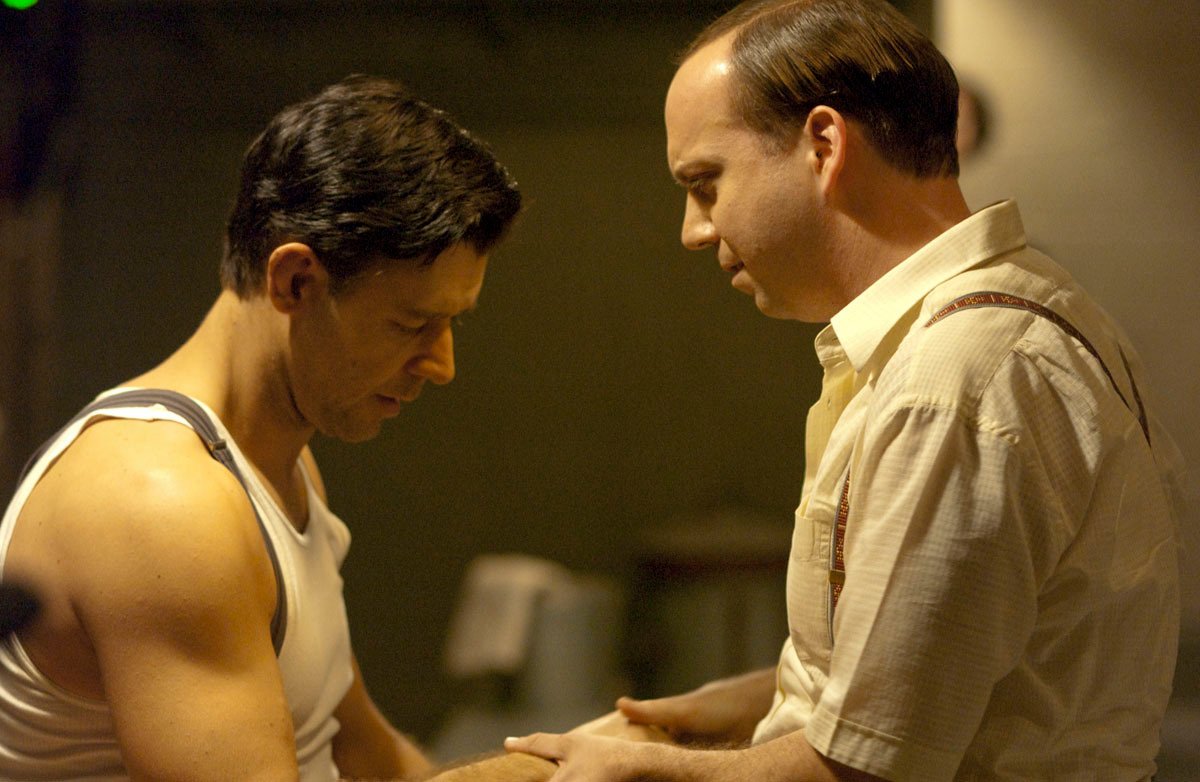

| Field | Details |
|---|---|
| Movie Name | Cinderella Man (2005) |
| Director | Ron Howard |
| Writer | Cliff Hollingsworth, Akiva Goldsman |
| Lead Cast | Russell Crowe, Renée Zellweger, Paul Giamatti |
| Supporting Cast | Craig Bierko, Bruce McGill, Paddy Considine, Rosemarie DeWitt, Ariel Waller |
| Genre | Biography, Drama, Sports |
| Release Date | June 3, 2005 (USA) |
| Duration | 144 minutes |
| Language | English |
| Budget | Approx. $88 million |
| Box Office | $108 million (worldwide) |
| IMDb Rating | 8.0/10 |
WATCH NOW


Cinderella Man is a heartwarming true story and an excellent film, but it’s not perfect, and that’s a disappointment for a Ron Howard film, especially one starring Russell Crowe. Then again, the direction and lead performance make the film sing, the little ways in which it falters have nothing to do with them. More about that in a minute.
Jimmy Braddock (Crowe) is a moderately successful heavyweight champion who loses the use of his precious right hand around the same time everyone else loses, well, everything in the 1929 stock market crash. With his license revoked but his spirit uncrushed, Braddock goes to the docks every day, hoping to be picked out of a crowd for an honest day’s work. Each night, he returns to the only place that matters home, a tattered apartment brought to life by his wife, Mae (Renee Zellweger), and their children (Connor Price, Ariel Waller and Patrick Louis fantastic performers all). Erratic hard labor doesn’t bring in enough to pay the past due bills, so when Braddock’s trainer Joe Gould (Paul Giamatti) gets him reinstated to be the underdog of all underdogs in a one off fight, the has been boxer jumps at the chance. Amazingly, he wins, he keeps getting offered fights, and he keeps winning them. The guy is the Seabiscuit of boxers. The parallels to the Depression era gawky racehorse are myriad, but the central one is this they both became symbols of hope to a country that desperately needed some.
Braddock lands the chance to fight for the championship title against Max Baer (Craig Bierko), a man who has killed two opponents in the ring, and he jumps at the opportunity, despite the risks and his wife’s reservations. You know the outcome or they wouldn’t have made a movie about it, much less named it Cinderella Man but to Howard’s credit, the tension is sustained throughout, and the payoff is extraordinarily satisfying. The combination of Crowe’s performance and Howard’s direction draws you deeply into the movie, to the point where, as a viewer, you nearly become the protagonist.
This movie will undoubtedly be remembered come Oscar time. Technical aspects, like editing, costumes, set and sound design, and cinematography, are deserving of nominations. On the performance front, only Crowe and Giamatti excel, which is unfortunate. The chemistry between them, while inconsistent, is palpable, and their bond seems more powerful than the one between Crowe and Zellweger, the latter gets by on pouts and a Jersey accent until the film’s climax. Bierko, who has been mentioned as a possible Academy favorite, is good at being smarmy and evil, but aside from the physicality of it, the role of Baer isn’t that difficult.
Of the principals, only Crowe hits the ground running, it takes a good half-hour for the other players, including Zellweger and Giamatti, to warm up. The script, too, seems sluggish to start and is far from the polished excellence of A Beautiful Mind.
As the film gathers momentum, the viewer is drawn into it more and more. When a critic doesn’t want to take her eyes off the screen to write down notes, you know the film is engrossing. Crowe invites the audience into Braddock’s psyche, laying bare the fighter’s soul to the point where you will feel every jab you may even find yourself ducking punches here and there (don’t worry those around you will be doing the same). And you’ll wind up with a big, goofy grin on your face, cheering as if you’d won the bout yourself. Sure, those are clichés, but in this case, they’re true.
The most memorable non boxing scene is one in which Braddock, whose pride has been well established, must return to Madison Square Garden, to the offices of the Boxing Commission, and beg for handouts so he can get his electricity turned back on and his children returned to him. Crowe plays the scene quietly, he knows that we know how difficult it is for Braddock to beg. Howard’s direction is brilliant, when the room falls silent, it is utterly and enormously silent. The lack of a score in this scene is a textbook definition of why silence is more powerful than music.
Aside from Zellweger’s performance, there are a handful of problems.
A couple of scenes seem precious and manipulative, moments designed by a writer to be self-consciously creative rather than being organic to the story. What makes Cinderella Man work is its honesty, which begins with Crowe’s performance and expands to include the entire film. At times, there is a little too much Hollywood involved, but those moments are rare.
Note to set dressers
Snow does not cling to the bottom of railings. Bunches of pulled cotton on the ground look like pulled cotton, not snow. The movie was shot almost entirely in Toronto, so perhaps the LA-based team assumed natural snow would be abundant. Except that it was shot from the end of April to the end of August. (Summers aren’t that cold in Hollywood North.)
In all other respects, Toronto was the perfect city to stand in for Depression era New York. In addition to the defunct Maple Leafs Gardens serving as an authentic stand in for the original Madison Square Garden, many of its dark brick buildings still stand, and the city is littered with the kind of back alleys and drop down fire escapes that give Cinderella Man its visual character.
Despite the fact that this is a film about men who make money beating the living daylights out of one another, it is rated PG, perhaps the first boxing film to land such a mild rating. The fight scenes are stunningly choreographed, performed, filmed, and edited; both the physical and the emotional impact are delivered with virtually no gore.
Cinderella Man is a long movie 144 minutes. It isn’t one of those long movies that zips by, but neither is it one that feels never ending. It’s one of those rare films for which the length is just right, the entire two plus hours are completely compelling.
To watch more movies like Cinderella Man (2005) visit Fmovies.
Also watch