

| Field | Details |
|---|---|
| Movie Name | Citizen Kane (1941) |
| Director | Orson Welles |
| Writer | Herman J. Mankiewicz, Orson Welles |
| Lead Cast | Orson Welles, Joseph Cotten, Dorothy Comingore |
| Supporting Cast | Agnes Moorehead, Everett Sloane, Ray Collins, George Coulouris, Ruth Warrick |
| Genre | Drama, Mystery |
| Release Date | May 1, 1941 (USA) |
| Duration | 119 minutes |
| Language | English |
| Budget | Approx. $839,000 |
| Box Office | Approx. $1.6 million (initial run) |
| IMDb Rating | 8.3/10 |
WATCH NOW



What was it about Citizen Kane that angered Hearst so? Well, in the days before media moguls like Rupert Murdoch became so smugly self satisfied that they will willingly lend their voices in self parody on The Simpsons, it just wasn’t done to criticize the ruling elite. And there could be little doubt that the Charles Foster Kane (Welles) invented by Welles and co-writer Herman J.
Mankiewicz was based on Hearst. Like Hearst, Kane’s fortune originally derived from his family’s mining interests. Kane, too, began with one small, struggling newspaper devoted to championing the disenfranchised only to expand nationwide and to lose his taste for the underdog as his ultimately unsuccessful political ambitions took hold of his soul. As with Hearst, Kane abandoned his first wife for the charms of a younger woman and installed her in a grandiose castle of his own making.
But the cold austerity of Kane’s Xanadu didn’t come close to approximating the vibrancy of Hearst’s San Simeon, a magnet for the rich at play. And Kane’s untalented soprano lover Susan Alexander (Dorothy Comingore) scarcely resembled Hearst’s mistress, actress Marion Davies, a talented comedienne who remained steadfastly loyal to her fatherly paramour. According to many accounts, it was this slap at Davies that really sent Hearst into pit-bull attack mode over Citizen Kane.
But if all Citizen Kane had to offer was a thinly veiled account of the life of a barely remembered press baron, then it would scarcely sit atop so many best-of lists. But the film that the then 25 year old wunderkind Welles set on conquering Hollywood as he had earlier ruled Broadway and radio and with an unprecedented contract in hand giving him complete creative control proffered was so much more than that potentially tired story.
A master of ballyhoo (this was the man, after all, who scared the wits out of the American public with his 1938 War of the Worlds radio broadcast), Welles presented Kane’s life as an elliptical puzzle for the viewer to solve. After beginning with Kane’s death and a newsreel that lends his life a chronological shape, the film unfolds through the flashbacked and sometimes suspect memories of Kane’s contemporaries. Susan, estranged friend and colleague Jed Leland (Joseph Cotten), faithful life long associate Bernstein (Everett Sloane), cynical butler Raymond (Paul Stewart), and the memoirs of Kane’s early guardian Thatcher (George Coulouris) all open up to reporter Jerry Thompson (William Alland) as he attempts to uncover the meaning behind Kane’s final word, “Rosebud.”
With a series of sharply etched characterizations, led by Welles’ at once autocratic and pathetic Kane, and a fascinating story told in an equally enthralling manner, Citizen Kane was bound to be a great film. Gregg Toland’s legendary black and white cinematography renders Kane absolutely transcendent.
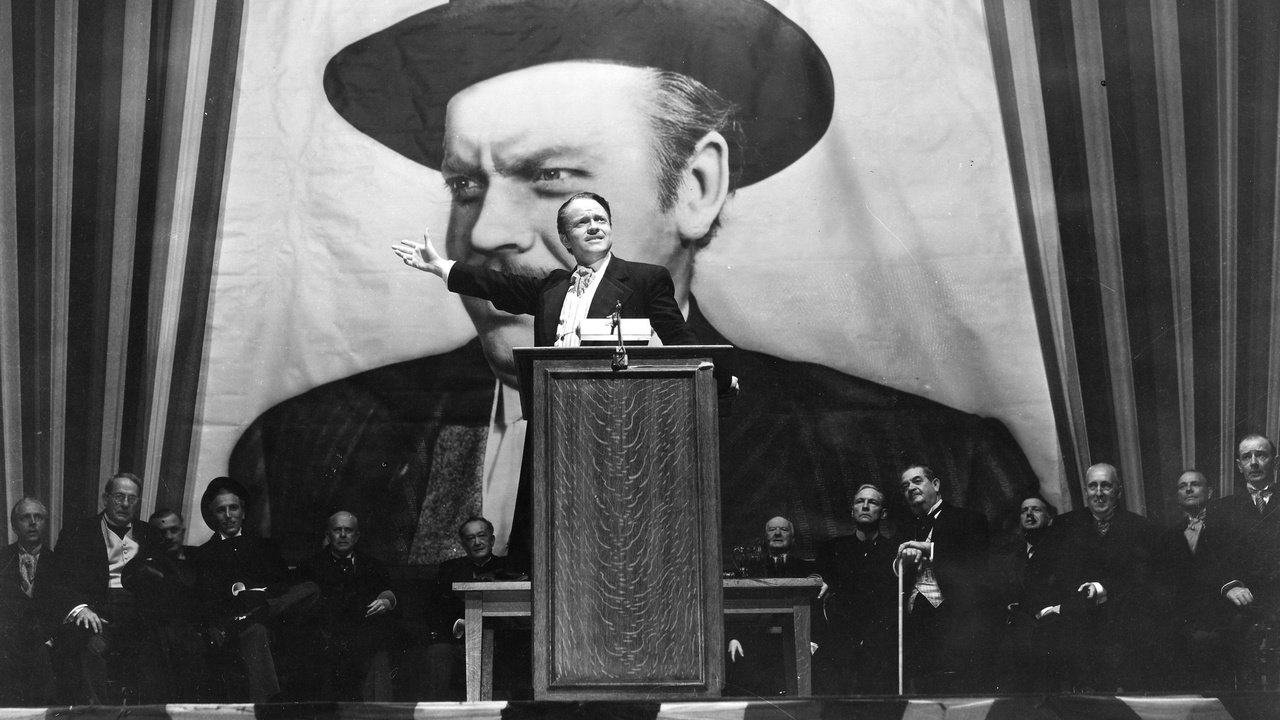
This was the film that pioneered the use of deep focus photography, where the entire image from close objects in front to those in the far distance remains in focus. With some shots this could only be achieved through the wizardry of the optical printer, others by pioneering new photographic and lighting techniques, and the results are stunning. Kane’s arena is larger than life, as he is. In the newsroom with its low ceilings and in exchanges with Susan both instances often shot from below so Kane looms even larger Kane truly bristles with power. But in many other scenes, particularly in the isolation of Xanadu or in the large hall underneath a towering poster of himself when he runs for governor, Kane is dwarfed by his surroundings, laying naked the essential smallness of this “big” man. The acute focus of Toland’s cinematography only serves to heighten the effects.
To watch more movies like Citizen Kane (1941) visit Fmovies.
Also watch