

| Field | Details |
|---|---|
| Movie Name | Compulsion (1959) |
| Director | Richard Fleischer |
| Writers | Richard Murphy (screenplay), based on the novel by Meyer Levin |
| Lead Cast | Orson Welles, Dean Stockwell, Bradford Dillman |
| Supporting Cast | Diane Varsi, E.G. Marshall, Robert F. Simon, Martin Milner, Gavin MacLeod |
| Genre | Crime, Drama, Thriller |
| Release Date | April 1, 1959 (USA) |
| Duration | 103 minutes |
| Language | English |
| Budget | Not officially disclosed |
| Box Office | Approx. $1.6 million (USA rentals) |
| IMDb Rating | 7.4/10 |
WATCH NOW

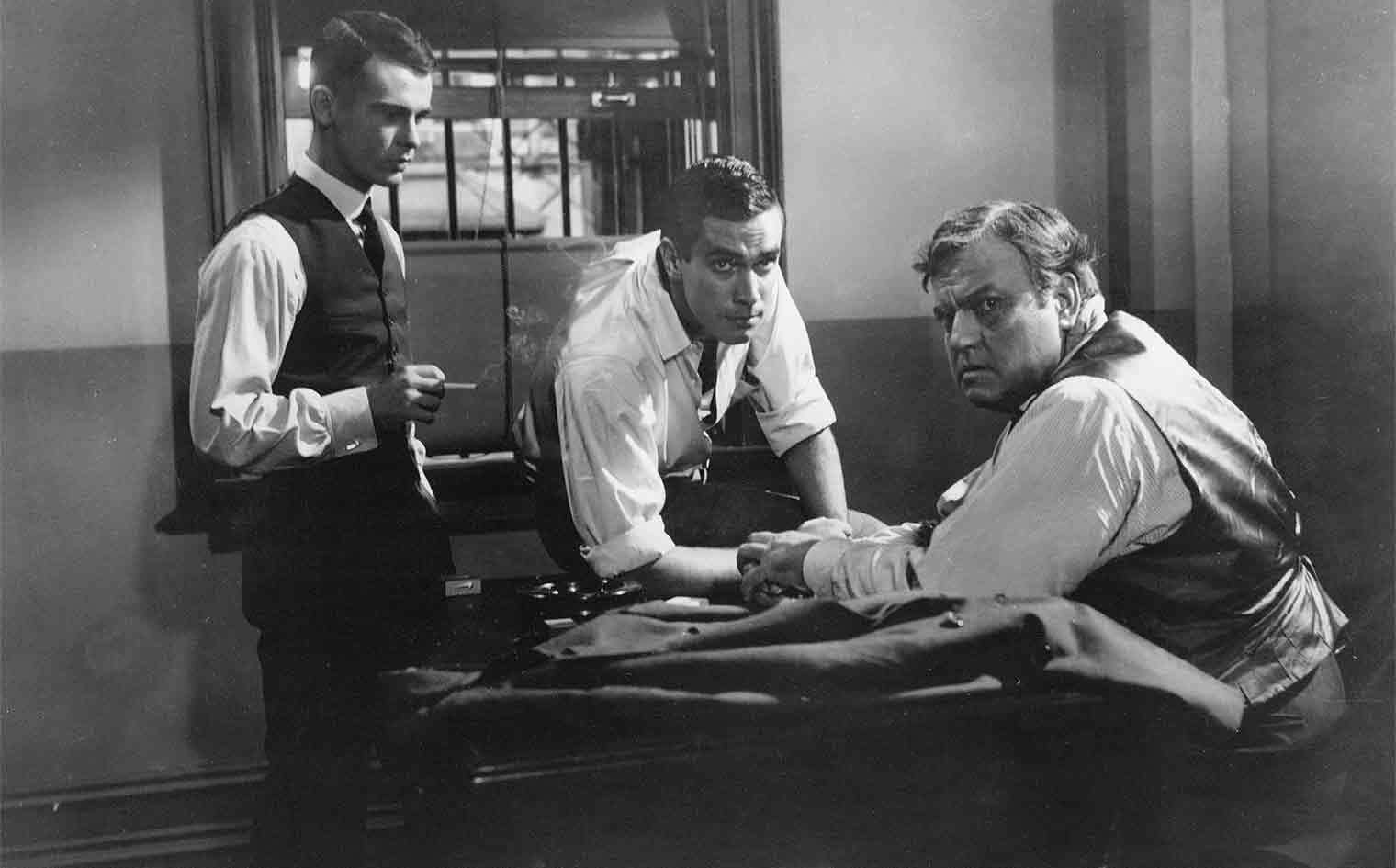
In its day, Compulsion, a recounting of the infamous 1924 Leopold and Loeb murder trial, may have seemed, well, compelling. But by today’s standards Richard Fleischer’s biopic feels too sketchy and melodramatic to satisfy as either a crime thriller or a courtroom drama, despite an excellent supporting turn by Orson Welles as defense attorney Clarence Darrow (or, as he’s called here, “Jonathan Wilk”).
In fact, Welles’ performance as the legendary lawyer is so strong it lifts up the rest of the disappointing film, even though the acclaimed actor doesn’t appear until well past the mid point. He moves through an impassioned, if repetitive, summation speech with great power and integrity, thankfully steering clear of the scenery chewing one might have expected. Though Welles was only 49 at the time (and looked about as old), his character mentions fearing juries “for over 40 years.” Okay, so he’s a lawyer, not a mathematician. But Compulsion is hardly a movie that traffics in verisimilitude.
Bradford Dillman, who portrays glib, cavalier college student Richard Loeb (dubbed “Artie Straus”), was 28 when he shot the film, but he looks more like a professor than a teenager. As Loeb’s persnickety partner in crime, Nathan Leopold (renamed “Judd Steiner”), Dean Stockwell was closer in age to his 18 year old character, but is hamstrung by a self-conscious, often risible rendering of the tense weirdo. In reality, however, the wealthy Leopold and Loeb were 16 when they brutally murdered a child as “a true test of the superior intellect,” so their ages were fudged here to begin with.
Then there’s the proverbial “elephant in the room”: the murderous pair’s homosexuality. Though the movie was made in the censor happy 1950s, Richard Murphy’s script (based on the novel by Meyer Levin) pussyfoots around the then explosive issue to such a degree it’s hilarious. A hip film festival audience would have a field day with the movie’s dated, transparent dialogue.
When, for example, his older brother Max (Richard Anderson) demeans Judd’s unusually close bond with pal Artie by asking, “Don’t you two ever go to a baseball game or chase girls?” you wish the seething Judd would level him with something like, “No, you cretin, we’d rather redecorate this hideous living room, then go watch The Wizard of Oz!” But that’s nothing compared to an earlier line, where Artie berates an unnerved Judd with “You said you could take orders, you said you wanted me to command you!” Though filling in the blanks can be fun, it doesn’t exactly make for gripping storytelling.
Another problem is, though we briefly hear Artie and Judd plan “the perfect crime,” we never see its execution. The action picks up again after young Bobby Franks’ kidnapping and murder, and follows a standard investigation by Chicago District Attorney Harold Horn (E.G. Marshall) that eventually implicates the killers. After all the ping ponging the D.A. does between the suspects, only hearing about how he finally wrings a confession out of alleged “tough guy” Artie feels like a cheat.
Compared to, say, the recent Capote, which was such a searing study of both crime and character, Compulsion seems especially pedestrian. Better to check out the first film inspired by the sensationalistic crime, Alfred Hitchcock’s clever and subversive Rope. For a more graphic, contemporary take on the criminals, there’s also 1991’s Swoon.
To watch more movies like Compulsion (1959) visit Fmovies.
Also watch