

| Field | Details |
|---|---|
| Movie Name | Contempt (1963) |
| Original Title | Le Mépris |
| Director | Jean-Luc Godard |
| Writer | Jean-Luc Godard (based on the novel by Alberto Moravia) |
| Lead Actor | Brigitte Bardot |
| Cast | Brigitte Bardot, Michel Piccoli, Jack Palance, Giorgia Moll, Fritz Lang (playing himself) |
| Genre | Drama, Romance |
| Release Date | December 20, 1963 (France) |
| Duration | 1 hour 43 minutes |
| Budget | Approx. $1 million |
| Language | French, English, German, Italian |
| IMDb Rating | 7.5/10 |
WATCH NOW

Contempt is many things a treatise on art vs. commerce, a study of a relationship in crisis, a philosophical study of Homer’s Odyssey, and more and it’s also one of the director’s most approachable efforts. There are three parts to it the first looks at the conflicts on the set of a film production, the second roams restlessly around the flat of a bickering couple, and the third puts these two issues together and brings both to resolution.
The initial third is jaunty and satirical, with Godard poking fun at Hollywood producers, here in the guise of Jeremy Prokosch (a robust Jack Palance). Invited to watch the dailies from an adaptation of The Odyssey that he is financing, Prokosch rails against the director, Fritz Lang (played with in-joke finesse by Fritz Lang), and demands a rewrite from the film’s scribe, Paul Javal (Michel Piccoli). When Prokosch makes a vague pass at Paul’s wife, Camille (Brigitte Bardot), he sets part two in motion.
The most experimental and remarkable part of Contempt takes place in this middle section, as Camille and Paul begin an argument that will eventually sunder their relationship. In this sequence, wonderfully filmed by Raoul Coutard, Godard shows how emotions between two people can change irrevocably over the course of half an hour.
Paul and Camille go about their quotidian life, setting the table for dinner, using the toilet, and taking baths, but they also goad each other to further levels of anger. Their disagreement may have its genesis in Prokosch’s boorishness, but its tragic resolution has everything to do with their own respective personality flaws.
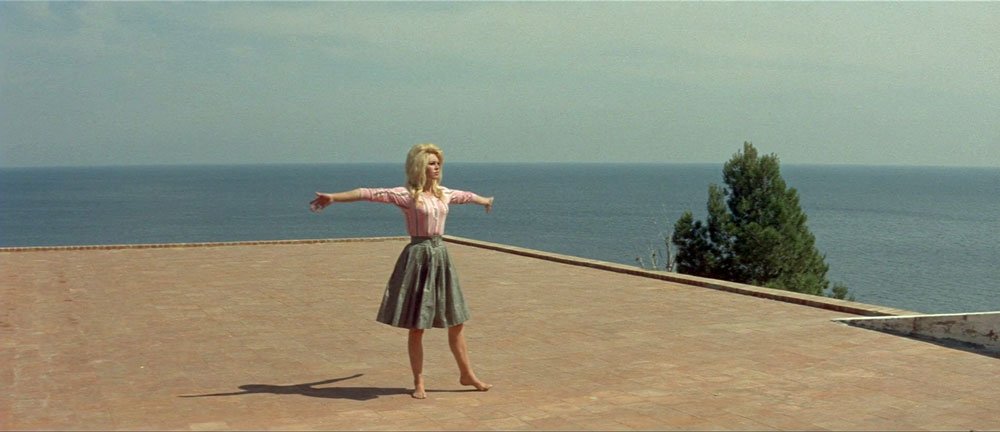
Contempt’s final third takes place on the set of The Odyssey, which is shooting on the gorgeous Italian island of Capri. All of the principals make their final appearances and arguments, and the film reaches its satisfying though partly inconclusive close.
The wonderful thing about Contempt is the multiple interpretations it allows. Whose fault is the argument between Paul and Camille? Is Fritz Lang’s version of The Odyssey (which we only see glimpses of) a work of artistry or is Prokosch right to condemn it as unwatchable? How can familiarity cease to breed contempt? Just how did Coutard get that gorgeous shot? And so on.
It’s a film that gains nuance and mystery with every viewing, full of remarkable ideas and performances. Though some of Godard’s movies lack real characters and thus remain entertaining but ultimately unsatisfying intellectual exercises, Contempt remains one of his finest and most full blooded efforts.
To watch more movies like Contempt (1963) visit Fmovies.
Also watch