
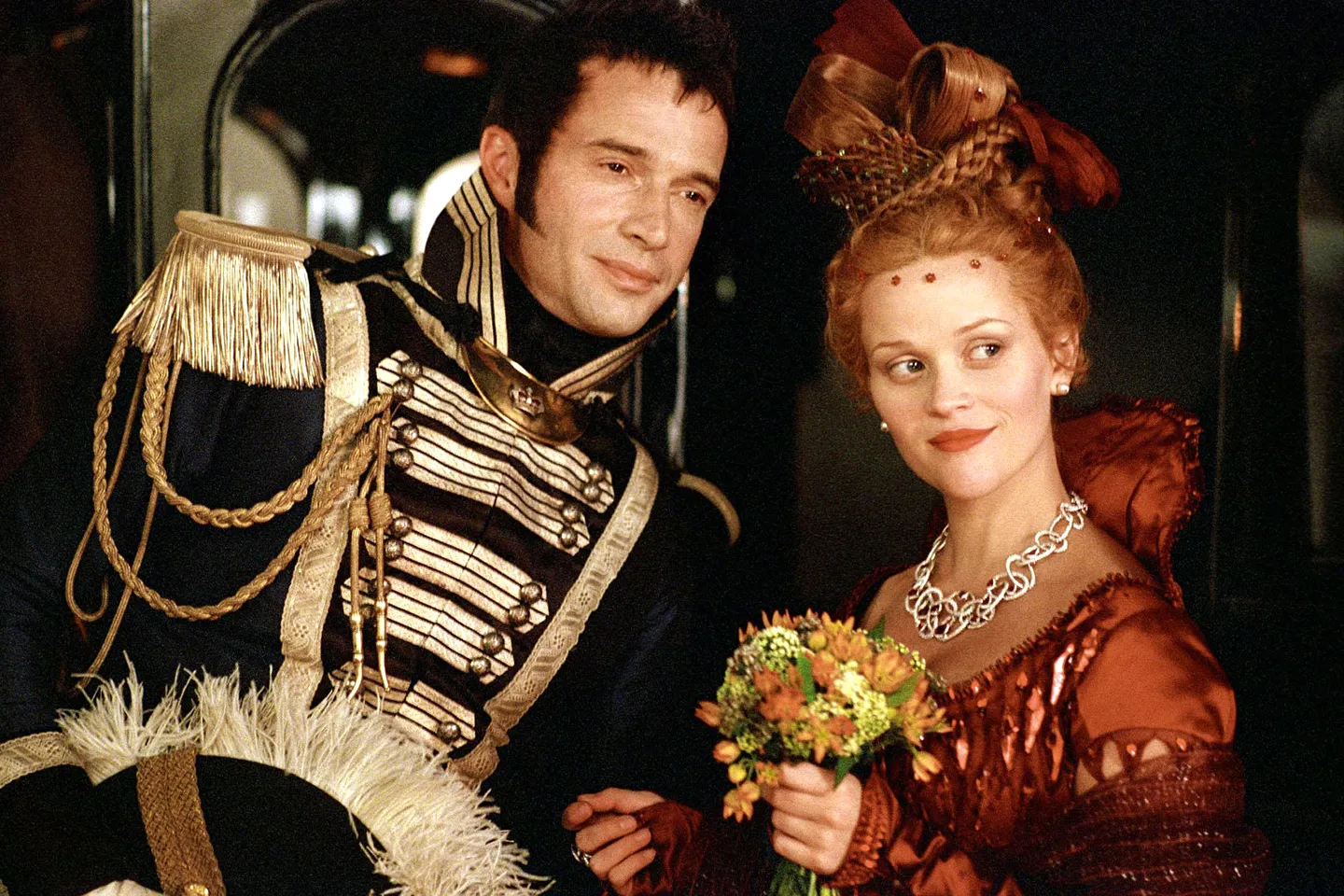

| Field | Details |
|---|---|
| Movie Name | Vanity Fair (2004) |
| Director | Mira Nair |
| Writer | Matthew Faulk, Mark Skeet, Julian Fellowes |
| Lead Actor | Reese Witherspoon |
| Cast | Reese Witherspoon, Romola Garai, James Purefoy |
| Genre | Drama |
| Release Date | September 1, 2004 (United States) |
| Duration | 2h 21m(141 min) |
| Budget | $23 million |
| Language | English |
| IMDB Rating | 6.2/10 |
WATCH NOW

One sign of an enduring classic is its ability to speak successfully to subsequent generations. The movie Vanity Fair translates the 1840 novel of William Makepeace Thackeray to the screen as a lush, vibrant period piece that still speaks to a 21st-century audience.
Writer Julian Fellowes (Gosford Park) and director Mira Nair (Monsoon Wedding) create a fast-moving plot with interlocking parts, driven as 19th century novels are wont to do by coincidence, chance and, of course, character. Becky Sharp is an orphan who graduates as a poor working student from finishing school with no opportunity to live the life she has been schooled in because she lacks both wealth and class stature. But she has the drive to acquire both.
“Becky Sharp,” says Mira Nair, “was a girl who bucked the system. She didn’t like the cards that society gave her. So she created her own deck.”
The complex plot offers a comparison between Becky (Reese Witherspoon) and her best friend, Amelia Sedley (Romola Garai). Where Becky is relentlessly positive and determined, the born to wealth Amelia is sweet, passive and self pitying. In the end, Becky is the instrument of Amelia’s awakening.
Nair gets a convincing performance from Witherspoon, creating a Becky who is at once sympathetic and selfish: determined not to be put down by life on the one hand and, on the other, willing to sacrifice even the love of her child for her ambitions. (Amelia’s mother observes of her, “I had thought her only a social climber. I see now she is a mountaineer.”)
In her drive for social acceptance, the talented and charming Becky never lacks for a mentor, trading up as she moves up. But when she marries into money her husband is disowned for marrying down. This adds the need for income to her need for social acceptance. When she crosses paths with the powerful Marquess Steyn (Gabriel Byrne) his name is pronounced “stain” she proceeds to accept his favors with the brash belief that she can control the consequences of her manipulations. But as Steyn tells her, “I never forget anything, least of all an unpaid debt.” His attempt to claim repayment causes her husband to abandon her.
It is ironically left for the selfish Steyn to state the theme of the film when he tells Becky that in spite of having everything he is not happy. The Thackeray story asks the ultimate questions, says director Nair “Which of us is happy in the world? Which of us having met our desires is content?” Steyn tells Becky that at last he has found the answer. The only thing of value in this life is to love and be loved. But even as he says it he does not know how to love, and neither does Becky yet.
The film’s social critique, embedded in the Napoleonic era, does not allow for easy judgments of the good vs. the bad, but it does leave room for reflection.
To watch more movies like Vanity Fair (2004) visit Fmovies.
Also watch